
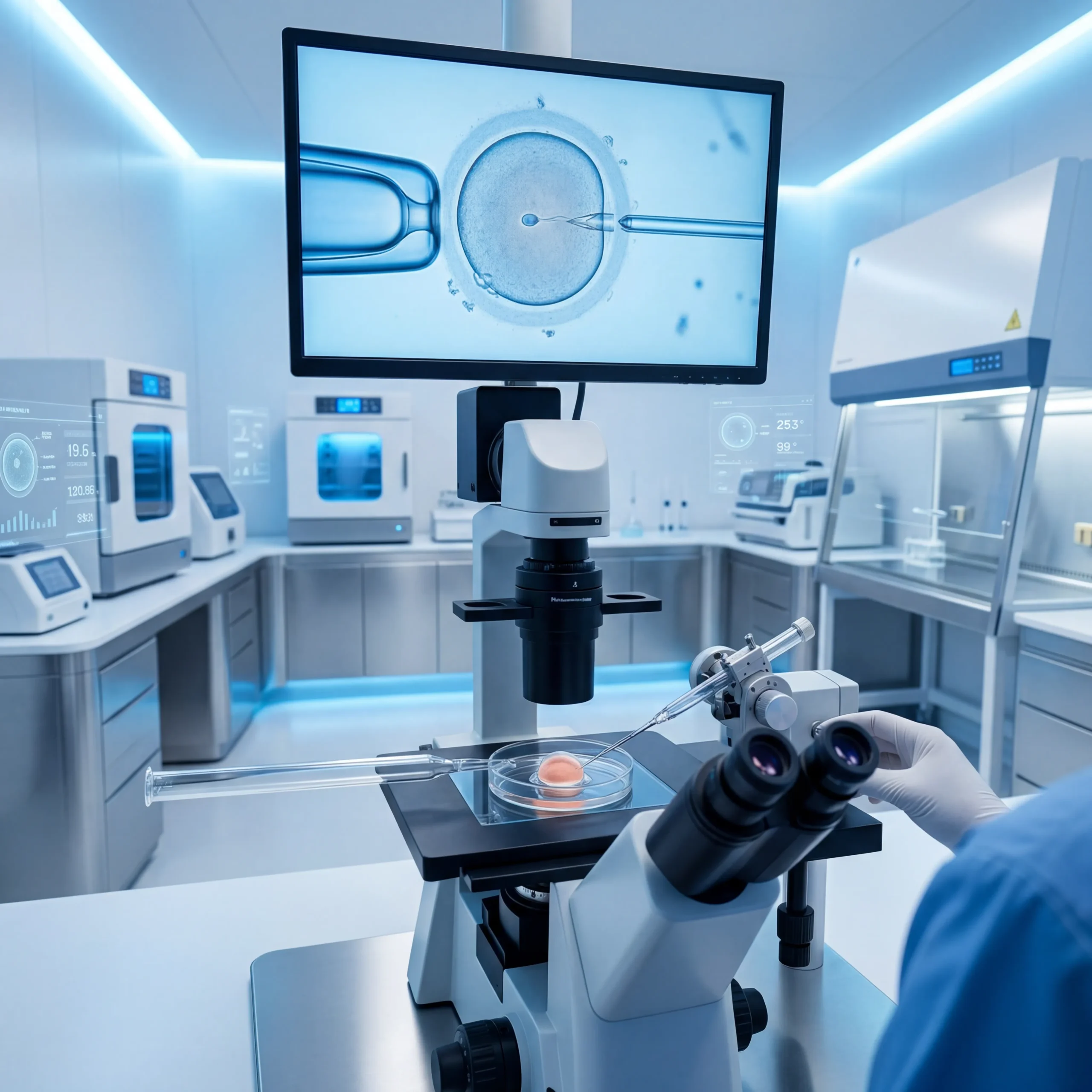
ICSI is one of the most advanced and effective delayed conception treatment techniques in modern medicine.
What is ICSI? Intracytoplasmic Sperm Injection (ICSI) is a highly advanced assisted reproduction technique in which a single, selected sperm is injected directly inside the cytoplasm of the mature oocyte using a high-precision micromanipulation microscope within the embryology laboratory.
This technique is the absolute standard of care for treating delayed conception, especially in couples facing severe male factor infertility, ovulatory disorders, or complete fertilization failure in previous standard IVF attempts. ICSI is highly indicated in cases such as: Severe sperm parameters weakness, complete fallopian tube obstruction, failure of artificial insemination (IUI), long-standing unexplained infertility, and advanced reproductive age after forty. The overriding objective of this procedure is to maximize fertilization and clinical pregnancy success rates.
Basic Stages of the ICSI Process:
- Ovarian Stimulation: Administering calibrated hormonal medications to stimulate the ovaries to produce multiple mature oocytes instead of a single one.
- Monitoring Oocyte Growth: Continuous monitoring of follicular tracking via ultrasound and serum hormone tracking to adjust medication dosages.
- Advanced Sperm Selection: The laboratory embryologist selects morphologically optimal, highly motile sperm under advanced magnification systems.
- Oocyte Retrieval (OPU): Aspiring mature follicles from the ovaries using a fine, ultrasound-guided needle under safe, light general anesthesia.
- Micro-injection Phase: Directly injecting the single chosen sperm into each mature oocyte under high-powered laboratory micromanipulators.
- Embryo Culture & Tracking: Monitoring embryo cleavage and cellular division symmetry within state-of-the-art embryo incubators for 3 to 5 days.
- Embryo Transfer (ET): Transferring top-grade embryos or blastocysts into the optimal zone of the uterine cavity using a highly specialized, non-traumatic fine catheter.
Detailed Phases of the ICSI Process:
01- Ovarian Stimulation: Hormonal medications are customized to stimulate the ovaries to produce multiple oocytes in the same cycle. Selecting the ideal protocol relies directly on: Patient’s age, AMH ovarian reserve test, previous ovarian response markers, and full medical history.
02- Monitoring Ovarian Response: During stimulation, follicular growth is sequentially tracked using transvaginal ultrasound scans and serum hormone panels. This close tracking enables the medical team to fine-tune dosages and accurately pinpoint the timing for the final maturation trigger.
03- Oocyte Retrieval from the Ovary: Oocytes are safely aspirated using a specialized fine needle under ultrasound guidance under light anesthesia, with immediate transfer to the adjacent embryology suite.
04- Selecting Sperm: The embryologist isolates the best sperm from the sample based on: Normal morphology, progressive motility, and genetic/material integrity, before performing micromechanical injection.
05- Monitoring Embryos inside the Incubator: Following successful fertilization, embryos begin cellular cleavage. They are evaluated thoroughly based on: Cell count, regularity of division, cell shape, and the absence of cellular fragmentation inside the embryo.