
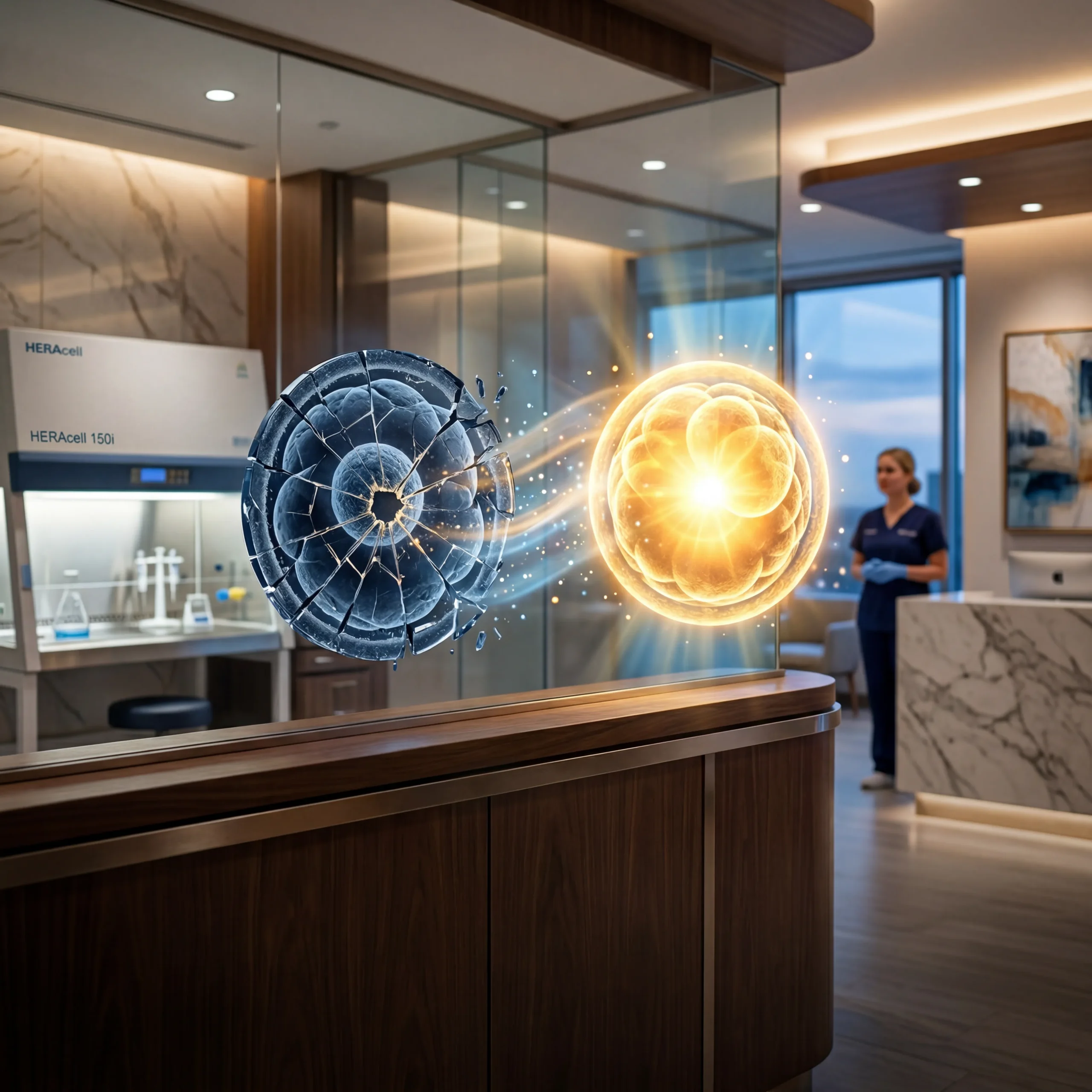
Why do some ICSI attempts fail? And how can success chances be improved?
Recurrent Implantation/ICSI Failure is clinically diagnosed as the lack of pregnancy after two or more consecutive ICSI cycles despite the transfer of high-grade embryos.
This condition necessitates an exhaustive, multi-angle diagnostic review. Repeating identical protocols without identifying the underlying physiological reason will likely yield the same outcome. Professor Dr. Ahmed Megahed implements a comprehensive diagnostic deep-dive to uncover the real cause of failure and construct an updated, customized treatment plan.
Primary Causes of Recurrent ICSI Failure:
01- Weak Embryo Quality: Even if a high number of embryos is obtained, hidden issues may exist, such as: Sluggish cell division, structural abnormalities in embryo morphology, or chromosomal aneuploidies. This prevents the embryo from successfully implanting within the uterine lining.
02- Endometrial & Uterine Problems: Successful conception depends heavily on the endometrium’s receptivity. Potential limitations include: Weak endometrial thickness, chronic endometritis, uterine polyps, submucosal fibroids, or intrauterine adhesions (scarring).
03- Timing Discrepancy between Embryo & Uterus: A critical mismatch can occur between the embryo’s developmental stage and the exact “implantation window” of the endometrium, preventing successful implantation.
04- Immunological Problems or Hypercoagulability (Thrombophilia): Certain cases present with an overactive immune system attacking the embryo or a systemic blood clotting tendency that blocks early placental vascularization and embryonic stability.
05- Weak Sperm Quality & DNA Fragmentation: Even within an ICSI setting, high paternal sperm DNA fragmentation or severe morphological weaknesses can negatively affect embryonic structural strength and cause early developmental arrest.
06- Unsuitable Treatment Protocol: Utilizing the same stimulation protocol or identical treatment tracks without addressing specific individual variations.
Prof. Dr. Ahmed Megahed deploys a meticulous, multi-dimensional clinical investigation matrix designed to identify and rectify hidden physiological barriers before initiating a subsequent therapeutic cycle:
- 01- Comprehensive Embryonic & Genetic Selection: Even embryos exhibiting optimal morphology under microscopic review may harbor significant chromosomal or structural defects. We mitigate this through Preimplantation Genetic Testing for Aneuploidies (PGT-A) via Next-Generation Sequencing (NGS). This advanced laboratory technique enables the screening of embryos for numerical chromosomal abnormalities, ensuring that only genetically viable, euploid embryos are selected for transfer to maximize implantation success and minimize miscarriage risk.
- 02- Advanced Uterine & Endometrial Evaluation: Successful conception relies equally on embryonic quality and endometrial receptivity. We perform state-of-the-art Diagnostic and Operative Hysteroscopy for direct visualization of the uterine cavity, facilitating the immediate surgical correction of subclinical pathologies such as polyps, fibroids, adhesions (Asherman’s Syndrome), or septa. Concurrently, endometrial biopsies are utilized to rule out Chronic Endometritis (silent inflammation), a critical hidden etiology in recurrent failure.
- 03- Precision Mapping of the Implantation Window: In numerous complex cases, a biological displacement of the standard implantation window occurs. We utilize the Endometrial Receptivity Analysis (ERA) molecular assay to measure gene expression profiles, enabling a Personalized Embryo Transfer (pET) specifically timed to the exact hour of peak uterine receptivity.
- 04- Immunological & Thrombophilia Profiling: A hyper-responsive maternal immune system may incorrectly identify the embryo as a foreign entity, impeding implantation. We conduct comprehensive screenings for Antiphospholipid Syndrome (APS), Natural Killer (NK) cell activity, and inherited Thrombophilias (clotting disorders). Management includes tailored immunological therapies (corticosteroids/intralipids) and precision anti-coagulant protocols (LMWH and Aspirin) to protect early placental vascularization.
- 05- Overcoming Male Factor & Genetic Integrity Barriers: Beyond standard parameters, we evaluate the internal genetic material of the sperm. A high DNA Fragmentation Index (DFI) can trigger developmental arrest or failure. We utilize next-generation sperm selection, including Physiological ICSI (PICSI) and Magnetic-Activated Cell Sorting (MACS), to filter damaged gametes and select those with superior genetic integrity.
- 06- Total Clinical Protocol Personalization: Professor Ahmed Megahed fundamentally redesigns the Controlled Ovarian Stimulation (COS) track, utilizing advanced antagonist or dual-trigger regimens tailored to the patient’s metabolic profile to optimize oocyte maturity and clinical outcomes.